
When thinking about how to study, a good starting place is the distinction between passive and active learning. Passive learning means taking in information without engaging more deeply. Avoid using passive strategies because they take up time without as much benefit. Active learning means processing information by using it. This might involve explaining, summarizing, reflecting, analyzing, problem-solving, synthesizing, questioning, or practicing.
Using active learning in your study routines helps you deepen learning, strengthen long-term memory, and apply what you learn in new situations. There may be times when passive strategies are useful, but they should not replace active strategies. You can increase your ability to learn new concepts or ideas by looking at relationships between ideas, understanding how ideas are connected to big-picture concepts, and relating new information to what you already know.

Examples of Passive Strategies
- Rewrite notes
- Reread chapter summary & outline
- Memorize theories
- Reread textbook
- Highlight material
- Reread highlighted material
- Review flashcards (in a superficial way)
Examples of Active Strategies
- Explain ideas in your own words after reading, watching a video, or attending a lecture
- Write down questions as you read, watch, or attend
- Answer practice questions and solve practice problems without references
- Relate academic concepts to real-life examples
- Develop a concept map, chart, or diagram to organize ideas visually
- Break diagrams down into smaller parts to explain how each part of the process works together
- Participate collaboratively in group discussions and study sessions
- Create and review flashcards (in a way that relates different terms and asks critical questions)
- Active Strategies and the Learning Cycle
-
What to do: Put active studying into practice with the five steps of the Learning Cycle.
- Make a study plan
- Prepare for class
- Attend class
- Review actively
- Plan your next study session
The goal is to organize your time in a routine that allows your learning to strengthen over time.
Pressed for time? Remember, effective study tasks can be incorporated into smaller blocks of time, wherever you can fit them in. Whether you’re working, caring for others, or navigating challenging circumstances, active strategies can have an impact even in short study blocks.
1. Make a study plan
Consider what you need to learn during the upcoming week, and what strategies will help you learn it. Break down assignments into smaller parts so that you can take action throughout the week and make progress towards long-term deadlines.
2. Prepare for class
Preparing for class enables you to process new information effectively. One effective way to enhance your learning is activating prior knowledge, in other words, refreshing what you have learned in the past and making connections to new information. It doesn't have to take long. By simply writing down what you already know about an upcoming topic, your brain will be ready to make new connections. Here are some additional strategies you can use:
- Actively review the previous lecture
- Use the syllabus or posted lecture slides to preview the upcoming lecture
- Write down what you already know about the upcoming lecture
- Write down questions that you can't answer on your own about the lecture
- Prepare an outline for notetaking
- Read using the SQ3R method
3. Attend class or engage in learning activities
When you are in class or engaging in readings or videos online, minimize distractions, ask questions, and use the time to begin processing new information. This will save you time later so that you don’t have to start from scratch and teach yourself.
- Listen actively and answer the questions you prepare before class
- Stay engaged by clarifying challenging concepts and contributing to discussions
- Take notes in your own words on key ideas and examples that the professor emphasizes
- Use shorthand abbreviations to take notes more efficiently
- Explore additional Note-Taking Strategies
4. Review after class or learning activities
This step has the greatest impact on your ability to process new information and remember it. Within 24 hours after you go to class or take in new information in other ways, use active strategies to review. This also applies to videos and readings. It has been shown that we might feel familiar with new information if it is presented clearly, but that does not mean we have mastered it. Testing yourself and actively processing new information ensures you really learn it.
5. Plan your next study session
Reflect on how your studying went in the last week, and how well your plan worked. Revisit the list of active strategies above to decide what will work best for which kinds of tasks going forward.
- Spaced Repetition
-
What to do: Space out your studying and practice consistently over time to strengthen your memory and understanding.
To build long-term memory, use spaced repetition: Review a concept or practice a skill consistently over time. You may find it difficult to devote long stretches of time to studying and college assignments. The good news is that our learning sticks best when we space out our practice, and that can still be done even with short study blocks. We quickly start forgetting what we learn. Research has shown that when we persist through the struggle to retrieve information from memory, we strengthen our ability to remember it again in the future.
This will also be helpful when you are preparing for a test or working on a large paper or project. Break them down into smaller steps to make steady progress leading up to the deadline.
Working full-time? The benefit of spaced repetition is that you can build on your learning and memory without having to commit to long study sessions - even if it is only 15 minutes here or there throughout your day.
- Self-Testing & Test Prep
-
What to do: Test yourself on information you are learning in ways that reflect how you will be tested later.
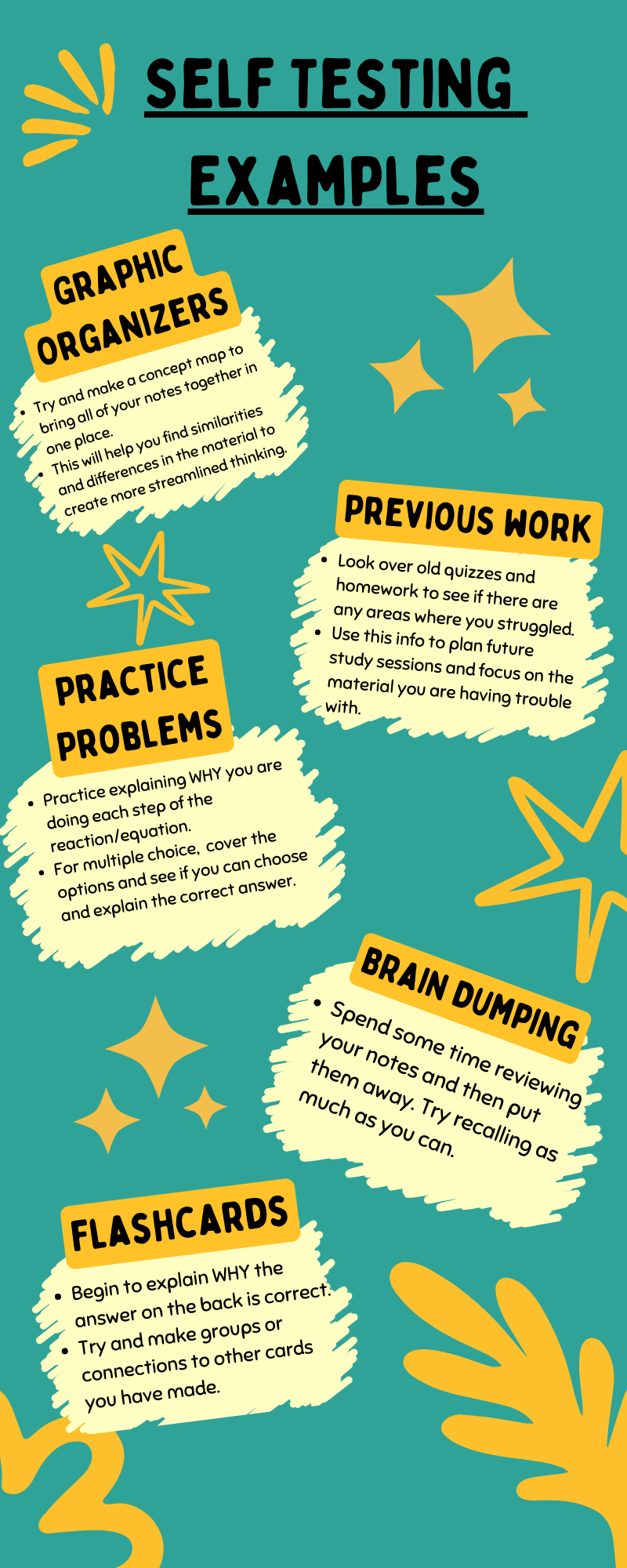
Self-testing means attempting to answer questions and solve problems from memory, with minimal reference materials. This retrieval practice is usually difficult, but it is a “desirable difficulty” or “productive struggle.” The struggle of solving a problem or responding to a question will help you learn it better than just looking up the answer. After you’ve attempted a question or practice problem first, then look it up to check your answer or solution. Ask yourself which steps you made errors in, and how to correct that in the future. If these strategies reflect how you will be tested on an exam, you will be better prepared.
Test Prep
What to do: Start preparing about 7-10 days before a test.
The key is consistent self-testing and active studying in a weekly routine. Test yourself repeatedly in ways that mirror the tests you will take in the course (or other kinds of assessments). This kind of continual test prep will set you up so that the week or two before a test you can focus on the areas you struggle with most.
That said, start preparing more strategically around 7-10 days before a test. First lay out the topics that will be covered and the type of questions the test will ask. Then determine what you know and what you don't know. Active strategies and practice exams can help you identify which concepts you have learned and which concepts you need to strengthen. Prioritize the areas you need to strengthen in the days leading up to the test.
More resources can be found through Study Lab.
Busy schedule? Plan ahead for the week leading up to an exam or a paper deadline. If you can adjust any aspects of your schedule, you will be more prepared for longer study sessions.
- Graphic Organizers & Higher-Order Thinking
-
What to do: Organize the information you are learning in visual ways to help you make sense of it.
Graphic organizers are one way we can process information and make meaning out of it. They deepen our thinking and strengthen critical thinking. For example, a concept map allows you to visualize the way different ideas are connected, compare related concepts, and understand a topic from the big picture as well as the details. The kind of organizer you create or use will depend on the content you are learning.
Are you an adult student? Make connections between what you're learning and the experiences and knowledge you've gained. These connections can strengthen your grasp of new information.
Higher-Order Thinking Questions
What to do: Ask yourself questions that push you to think more deeply about a topic, especially in ways that reflect what will be on a test.
College-level courses are designed to help you learn higher-order thinking. You will be able to solve problems you have never encountered and apply what you learn in new situations. To build Higher-Order Thinking, use the questions How, Why, and What If for whatever material you're learning.
- How: How does this process work? How does this concept relate to this other concept? How do we know this is true?
- Why: Why does this process work this way? Why is this part of the diagram necessary? Why is this concept important for the big picture?
- What If: If this part of the diagram was changed, what would happen? What if this increased, what would happen to the rest of the process? What if circumstances changed, how would that affect the situation?
- Adapting to a Non-Traditional Schedule
-
Here are tips to help you adapt to your unique schedule, whether you are taking online or evening classes, balancing caring for others at home, or navigating a job while being a student:
- Make connections between what you're learning and the experiences and knowledge you've gained to strengthen your grasp of new information
- Plan ahead for the week leading up to an exam or a paper deadline so you are prepared for longer study sessions.
- Effective study tasks can be incorporated into smaller blocks of time, wherever you can fit them in.
- The benefit of active review is that you can keep learning without having to commit to long study sessions - even if it is only 5 minutes immediately after and 15-30 minutes here and there 24-48 hours after
- Include non-academic tasks, such as responsibilities at home, in your weekly task list and schedule, and if possible, build them into your routine
- Move routine tasks from one day to the next (or previous) as needed to adapt to other responsibilities – if you can't review lecture notes after an evening class, do it the next day instead
- Schedule a learning block for completing learning activities for asynchronous courses
- Schedule separate hours during each day for school versus work versus rest/family/home to create structure
- Prioritize tasks, especially if consistency is difficult to maintain
The content on this page is adapted from Study Lab.